Keyword Rankings
Monitor how well your products are found for relevant search terms on Amazon. The Keyword Ranking Tracker shows you current positions and how they develop over time.
Why Monitor Keywords?
- Understand visibility: See which search terms bring up your products
- Identify trends: Watch how your positions develop over weeks and months
- Catch problems early: Get notified when important keywords lose ranking
- Measure SEO success: Track whether your optimizations are working
Overview of Rankings
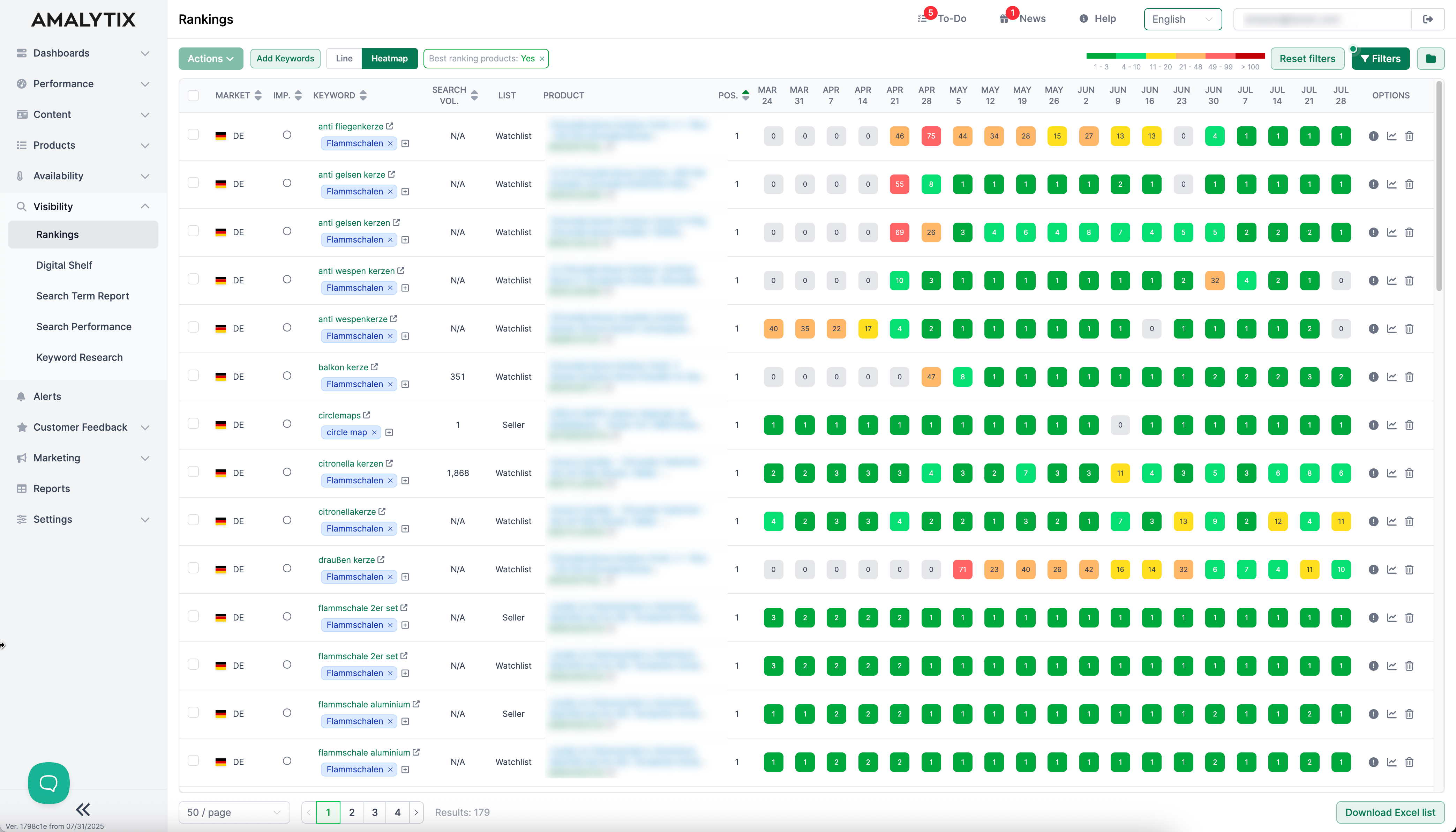
The Rankings page shows all your monitored keywords with current positions. You can choose between two views:
- Heatmap: Color-coded overview of positions across multiple weeks (default)
- Line: Classic table with trend chart
Heatmap View
The heatmap shows ranking development at a glance:
| Color | Meaning |
|---|---|
| Dark green | Position 1-3 (top placement) |
| Light green | Position 4-10 (page 1) |
| Yellow | Position 11-20 (page 2) |
| Orange | Position 21-48 |
| Red | Position 49-99 |
| Dark red | Position > 100 |
| Gray | No data |
Table Columns
| Column | Description |
|---|---|
| Market | Amazon marketplace |
| Important | Marked as important keyword (green dot) |
| Keyword | The monitored keyword with tags |
| Search Vol. | Estimated monthly search volume |
| List | Product source (Seller, Vendor, or Watchlist) |
| Product | Product image, title, ASIN, and brand |
| Position | Current organic position |
| Week columns | Historical positions (heatmap) or trend (line) |
Adding Keywords
To monitor new keywords, click on Add keywords.
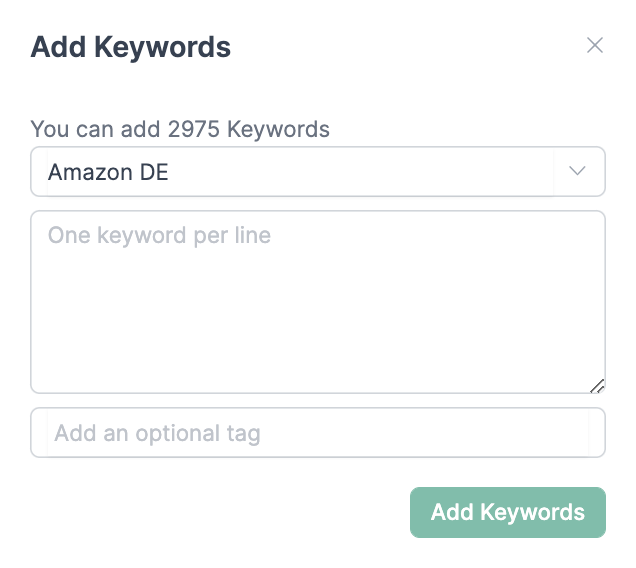
In the pop-up window:
- Select the marketplace
- Enter keywords line by line (one keyword per line)
- Optionally add tags to group keywords
- Click Save
After adding, keywords are automatically checked once per day.
Products and Keywords
AMALYTIX automatically displays rankings for products from the following sources:
- Seller Products: Your own seller products
- Vendor Products: Your own vendor products
- Watchlist: Products on your Watchlist
If a keyword ranks for multiple of your products, a separate row is shown for each product.
Filters and Actions
Available Filters
- Marketplace: Filter by Amazon country
- Importance: Show only important keywords
- List: Seller, Vendor, or Watchlist
- ASIN: Search for specific ASIN
- Keyword: Search by keyword text
- Product title: Search by product name
- Brand: Filter by brand
- Tags: Filter by keyword tags or product tags
- Products with best ranking: Shows only the best-ranked variant
Bulk Actions
Select multiple rows and use the Actions menu:
- Mark as important/not important
- Edit tags
- Delete selected keywords
- Copy ASINs
Marking Important Keywords
Click the exclamation mark under Options to mark a keyword as important. For important keywords, you can set up alerts that notify you when rankings deteriorate.
Chart View
Click the chart icon under Options to see a detailed graph of ranking development.
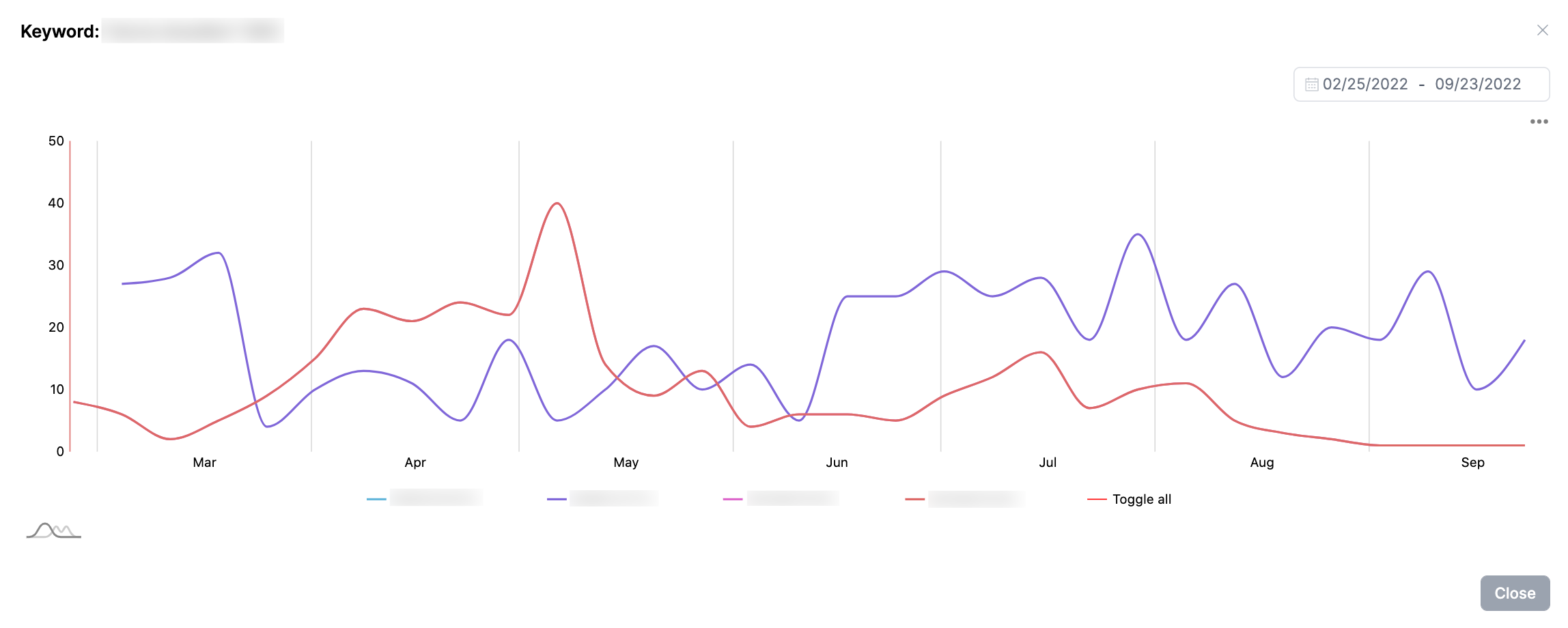
The chart shows all products ranking for this keyword. Click on a product name in the legend to toggle its line on or off.
Subscribe to Alerts
Get automatically notified when something changes with your keywords:
- Negative keyword found: A defined negative keyword was found in the product listing
- Keyword position has declined: An important keyword has dropped below a threshold
Activate these alerts under Settings / Alerts.
Export Reports
Export your keyword data for further analysis:
Keywords Report
- Contains all keyword rankings for your products and watchlist products
- Type: Seller and Vendor
- Category: Visibility
SERP Report (Keyword Search Volumes)
- Contains complete search results for all tracked keywords
- Type: Seller and Vendor
- Category: Visibility
Click Reports in the left sidebar and select your desired report.
Find a list of all columns here:
Tips for Usage
- Choose relevant keywords: Monitor keywords that your customers actually search for
- Use tags: Group keywords by product, category, or priority
- Mark important keywords: Set up notifications for your top keywords
- Check regularly: Ranking changes can be early indicators of revenue changes